
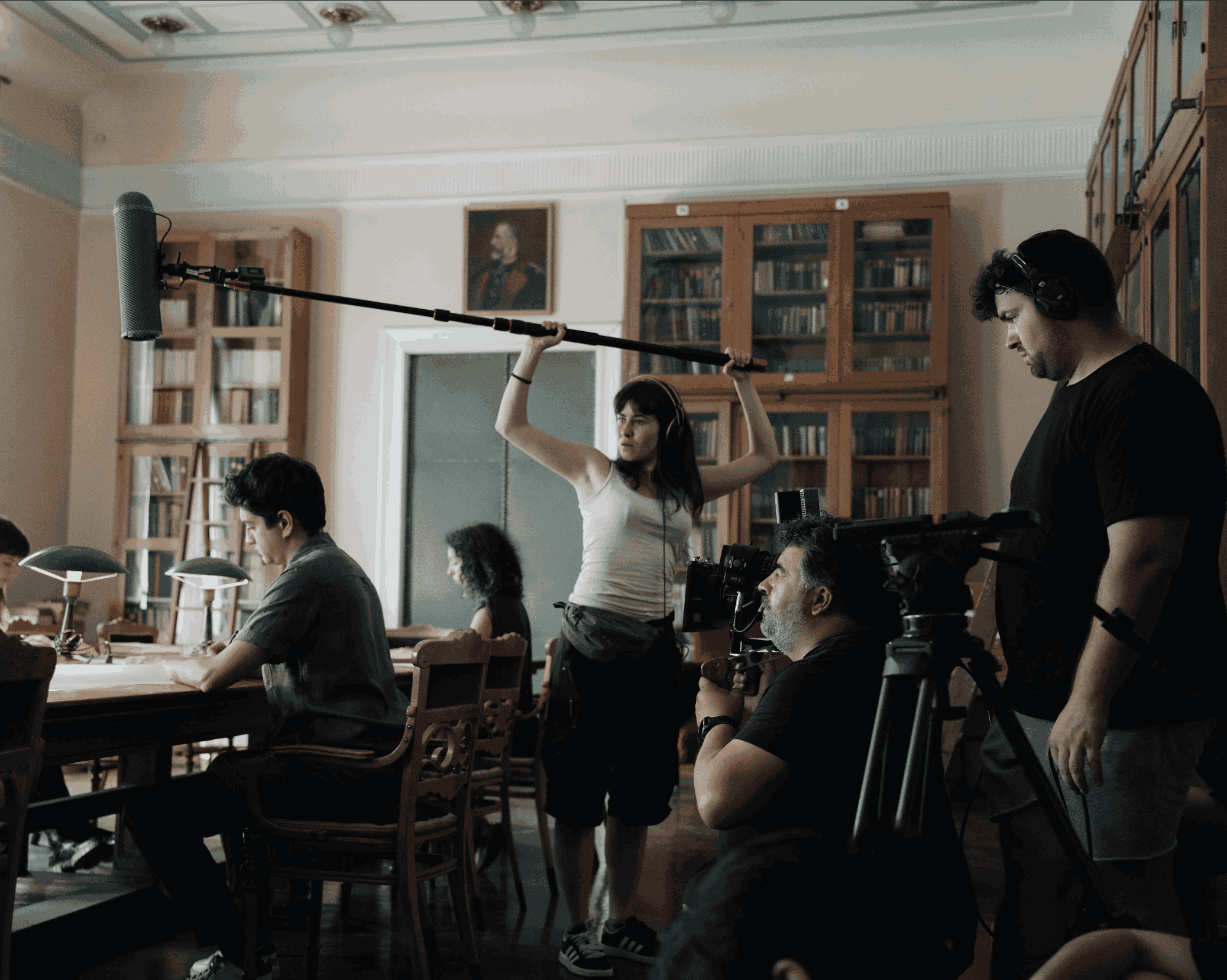
As we have described before on the blog, and on our social media channels, this summer we worked closely with Blue Youth Films on the feature film co-production Nimic mai mult și nimic diferit, directed by Lucas Neagu. To understand the creative process better, both on set, with director of photography Horațiu Curuțiu, and in the edit suite, with editor Eugen Kelemen, we asked them to tell us more about the way of working and the work ethic on an independent film production.

Lucas Neagu made his debut in 2024 with the feature film "Timing", which enjoyed great success on its release in Romanian cinemas. Now, after producing his second film, Nimic mai mult și nimic diferit, we were curious to find out more about his experience in Cluj and his plans for the future.
How did the film change from the first ideas through to its completion? What influenced those changes, if there were any?
"The film went through many changes, there were a lot of feedback sessions, especially during the rehearsal period with the actors. That is my way of working: once I feel the screenplay is ready, I start working on it with the actors, listening to their opinions and their needs and developing it further from there. Eugen Kelemen and Horațiu Curuțiu also contributed feedback, before production. Even so, the main idea of the film, its foundation let us say, stayed the same. An elderly couple facing the imminent reality of the end of a life."
How was the production process in Timișoara different compared with Cluj?
"In Timișoara, on Timing, my first feature, it was very much a passion project, shot in what the trade would call guerilla style. It was still ground I knew very well and, although it was hard work, I managed to operate successfully as a producer. On this new film I had the luxury of not having to worry too much about the locations myself, and it was a good thing it happened that way, because I was not very familiar with the city. Horațiu took care of that well and presented me with options. I chose. I learned a lot from both experiences."

How would you describe your collaboration as a director with the established actors Marian Râlea, Ana Ciontea, Áron Dimény and Johanna Adam? How is it different from working with Daria Pintilie and Vlad Lință, if it is?
"I think I always try to keep the same approach every time I work as a director, namely to give my actors as much creative freedom as possible. I am honoured to have had the chance to work with Marian, Ana, Johanna and Aron, all of them actors I never even dreamed of working with, and it makes me enormously happy that they decided to take part in this film without knowing me beforehand, simply by reading my screenplay and being deeply moved by the story. With Marian Râlea and Ana Ciontea we rehearsed a great deal and I will praise them whenever I get the chance, they are phenomenal actors. I appreciated with all my heart that they treated me as their equal, even though their experience is far greater. With the young Daria Pentelie and Vlad Lință, who are dear friends of mine, we worked with a great deal of trust and good humour. I rehearsed the most with them and they were the first to know about the project. We came, we rehearsed, we trusted our work and we delivered."
What impression do you want to leave with the audience who watch this film?
"Nimic mai mult și nimic diferit invites the audience to a celebration of life. I would like to think it will be perceived as a happy film and that the audience will leave with a thirst to live their lives beautifully, in quiet, peace and joy alongside the people they love. I hope they leave the cinema with a pleasant, warm feeling."
What advice would you give to young people starting out on a film career, and what are your plans for the future?
"I have said it before and I will say it again. As a young person wanting to set out on a path, whatever it is you want to do, you should be guided by a balance between two words: passion and sustainability. As for my plans for the future, I am trying to keep writing. I am working on two screenplays in parallel. If either of them materializes one day and I have the privilege of being able to continue this career, then that is wonderful. If not, we will see. I try to stay flexible. At the end of the day, all I want is to be healthy, happy and among the people I love."
Horaț iu Curuțiu, the founder of the production company Numa Film, director of photography and producer on dozens of local films, contributed on both fronts this time to the production of the feature "Nimic mai mult și nimic diferit".
How do you contribute to the screenplay through the images you create?
"I like to think that when I work on a film, through the images I create, I help the director tell their story. It helps that I have reached a certain maturity, so that I do not feel I have anything to prove, technically speaking. I am not one of those cinematographers who justify their shots through the equipment; I am more interested in understanding the directorial intention as well as possible, the narrative, the characters, so that I can use the camera to contribute to the way we are going to tell the story. On the film by Lucas it was the same, we had a great many discussions in pre-production about the story, the characters, the locations, essentially all the elements that can influence the way we were going to shoot, precisely in order to align ourselves creatively as well as possible. I think we managed to tell a coherent story, in a manner that is perhaps slightly different from what we are used to from a Romanian film, especially a low-budget independent one."

How do you manage a small technical crew within the limits of an independent film budget?
"I believe the crew is what underpins the production of any film. From the producer point of view, I think my job is to make sure I surround myself with the right people. More or less experienced, that matters less. The desire is there, we all dream of making films, so I choose to trust people and the whole team. I think it is a shared effort we have to make, we need the discipline to carry through what we establish in pre-production. From the perspective of an independent film budget, in Cluj our films have been financed mostly by ourselves, out of the profits generated by commercial projects. We have always considered it an investment in ourselves, in the local industry, and we have always done it with great pleasure."
What do you think this production means for the future of the film industry in Cluj?
"I like to think that what we do has relevance, although it is an independent feature film, and I hope this project will at least fuel the desire in some people to make a film of their own. In essence, this film ought to be a bridge between Cluj and Timișoara; just as in Cluj, there are a few people there who want to produce films locally. Perhaps we will see more Cluj and Timișoara collaborations from that point of view."
 Eugen Kelemen, editor of over thirty films, worked closely with director Lucas Neagu on the post-production of the film.
In the process of editing the film, how did this story take on new perspectives and forms? How faithful should the editor be to the original structure of the screenplay?
"The editor is the best friend of the screenwriter. Even so, taking into account the interpretative vision of the director, it can happen, and quite frequently, that the narrative structure changes in the edit suite. Not so substantially, of course, that the story itself is altered. There is one more element that can bring changes: the actor. Their performance can lead to a different perception, no matter how clearly it is explained in the screenplay. The emotions and the feelings imprinted on the image can reshape the working out of the original intention. This is proof that the edit contributes a great deal to the way the viewer perceives the film."